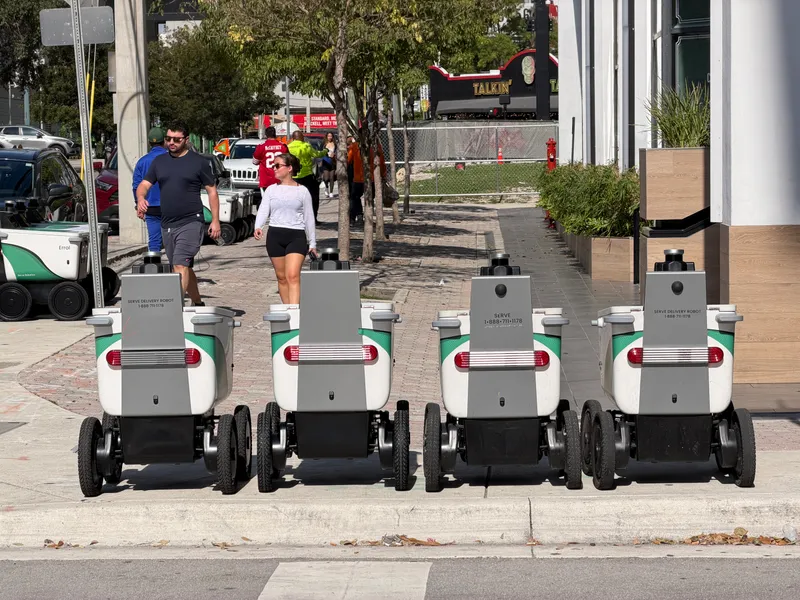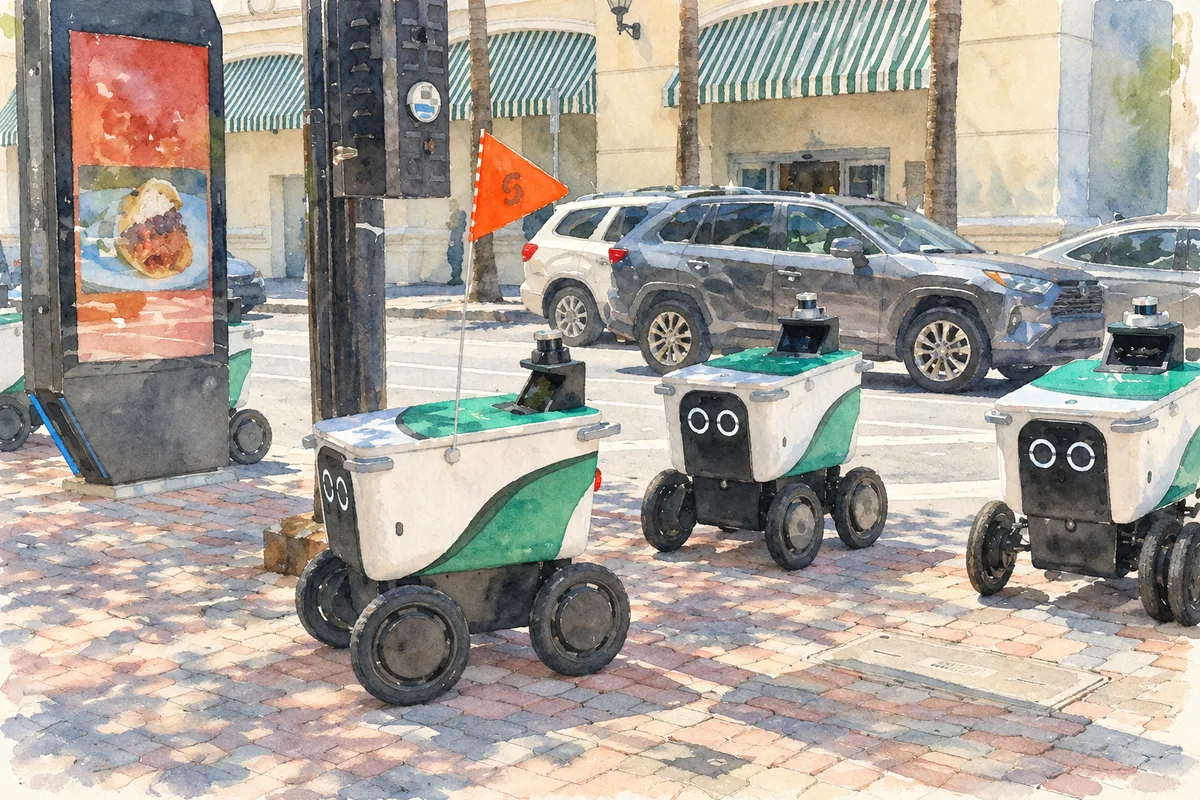
The little boxy robots rolling through Brickell, downtown Miami and Wynwood may soon have speed limits, parking rules and fines.
On Tuesday, Nov. 17, the Miami-Dade County Commission takes a final vote on an ordinance from Commissioner Micky Steinberg that sets rules for sidewalk delivery robots across the county. It is item 7(C) on the agenda. If it passes and the mayor does not veto it, it takes effect 10 days later.
Steinberg said the rules are not meant to stop the robots, WLRN reported. She has said the machines are already common in Miami Beach, Coral Gables and Miami's Brickell, downtown and Wynwood areas, and that the county should set rules before more arrive, Florida Politics reported.
The speed and sidewalk rules
Under the ordinance, a robot could go no faster than 8 mph on a sidewalk. The limit drops to 6 mph in high-pedestrian areas, which the county's transportation department would map out. In crosswalks, the cap is 10 mph, but a robot must come to a full stop before it enters one.
Robots must give pedestrians the right of way at all times. They could not block crosswalks, curb ramps, wheelchair ramps, fire hydrants, transit stops or bus loading areas. They would also be banned from school zones while school-zone speed limits are in effect.
A robot could not sit parked on a sidewalk for more than 30 minutes unless it is actively making a delivery. The county could create special zones where longer waits are allowed. Broken robots would have to be cleared from the sidewalk within six hours.
What operators would have to do
Companies would need a permit that lists every robot they run. In unincorporated Miami-Dade, the permit comes from the county. Inside a city, it comes from that city. Cities can write their own rules, and the county's rules apply in cities that have not.
Each robot would need front and rear lights, reflectors, a sound alert that reaches 15 feet, obstacle detection and an automatic stop if it loses its signal. Every robot must also show an ID number and a QR code or phone number that connects you to the operator. That is the number to use if one is stuck or blocking your way.
Operators must carry at least $100,000 in liability insurance, as state law already requires, and report any incident that injures someone or damages property within 24 hours. Ads on robots would be banned except under a separate deal approved by the commission.
The cost to the county
A county fiscal memo says running the program would take two new enforcement officers and a clerk, at about $251,773 a year in pay and benefits. It warns that permit fees and fines may not cover the cost, because only a few companies operate or test robots in the county today.
The proposal has changed since it began. The county's Transportation Committee amended it on Oct. 14, raising the idle limit to 30 minutes and allowing longer-wait zones. Coral Gables moved in June to set its own 7 mph sidewalk limit, Florida Politics reported.
If the rules pass, the mayor's office must report back to commissioners a year after they take effect on how enforcement is going.
How to follow the vote
- Tuesday, Nov. 17: Board of County Commissioners meeting, Stephen P. Clark Government Center, 111 NW 1st St., Miami. The ordinance is item 7(C).
- The full ordinance and fiscal memo are posted on the county's legislative site.
More on getting around the city: our Metromover guide to Brickell, downtown and Museum Park and a walking route through Brickell and downtown.